
Baby Vaccine Schedule by Age: EU vs US
"A side-by-side, source-linked guide to routine childhood vaccine timing in NHS England and the United States, plus what changes when you move, travel, or miss a dose."

A vaccine1 schedule is an address, not a universal calendar. A search for the “EU baby vaccine schedule” sounds as though Europe has one timetable; it does not. Each EU/EEA country sets its own national policy, and a country-by-country comparison tool exists because the recommended ages and products differ.
So this guide makes an explicit comparison:
- European example: the routine NHS schedule in England (checked 13 August 2026).
- United States: the CDC’s July 2025 birth-to-6-years schedule (checked 13 August 2026).
These are planning tables, not individual prescriptions. Birth date, previous doses, health conditions, travel, and catch-up status can change what is due; both the UK and US schedules tell families to check missed or special-case doses with their healthcare professional.
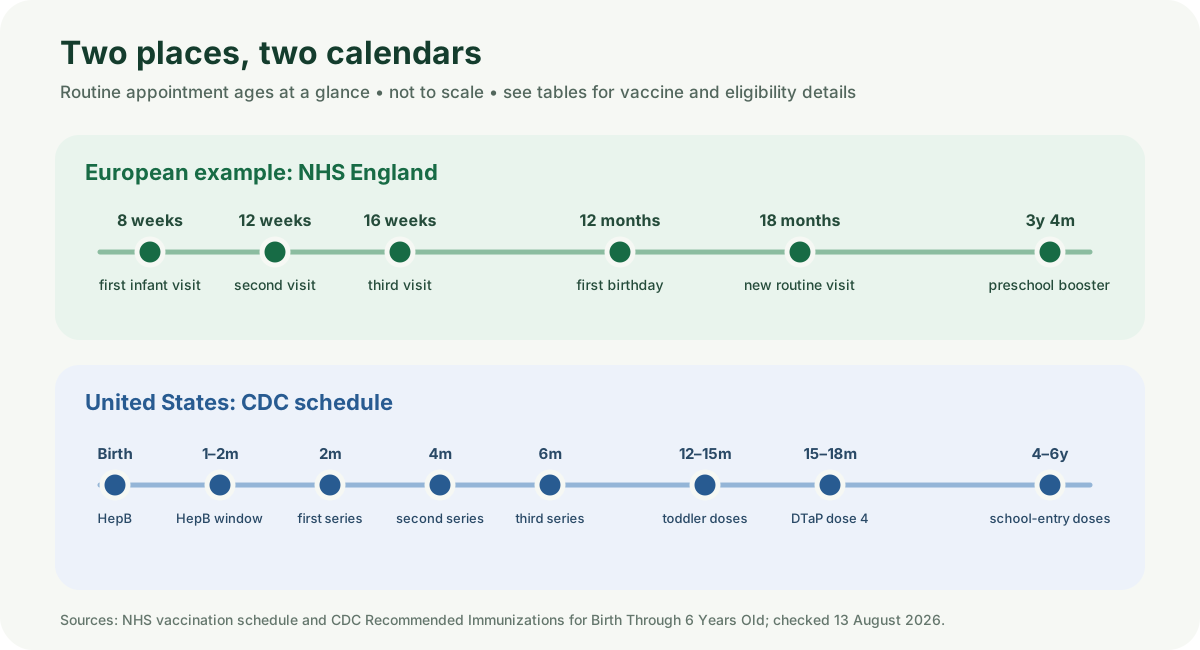
European example: NHS England schedule by age
This table describes routine vaccinations for a child born on or after 1 January 2025, the cohort covered by England’s newest MMRV sequence. It follows the current UK vaccination schedule and its birth-date rules for MMRV.
| Age | Routine vaccines | What the shorthand covers |
|---|---|---|
| 8 weeks | 6-in-1 dose 1; rotavirus dose 1; MenB dose 1 | 6-in-1: diphtheria, tetanus, pertussis, polio, Hib, hepatitis B; MenB: meningococcal group B |
| 12 weeks | 6-in-1 dose 2; rotavirus dose 2; MenB dose 2 | Second doses in the infant series |
| 16 weeks | 6-in-1 dose 3; pneumococcal (PCV) dose 1 | Completes the first three-dose 6-in-1 series |
| 12 months | MMRV dose 1; PCV dose 2; MenB dose 3 | MMRV: measles, mumps, rubella, varicella (chickenpox) |
| 18 months | 6-in-1 dose 4; MMRV dose 2 | Applies to the newer birth cohorts |
| From age 2 | Flu vaccine each year when eligible | The programme is seasonal and age/eligibility based |
| 3 years 4 months | 4-in-1 preschool booster | Diphtheria, tetanus, pertussis, polio |
The 6-in-1 guidance now includes an 18-month fourth dose for children born on or after 1 July 2024, while MMRV replaced routine MMR for eligible younger cohorts. An older sibling may therefore have a different-looking record without either child being “off schedule.”
Why this is not “the EU schedule”
National schedules vary with local disease patterns, health systems, and resources. The Vaccine Scheduler is the right next stop for France, Finland, Germany, Ireland, or another EU/EEA country. If your child started a series elsewhere, bring the original record rather than translating tables yourself; the tool was built to support continuity when families move.
United States: CDC schedule by age
The table below condenses the Recommended Immunizations for Birth Through 6 Years Old. Where a vaccine has a permitted age range, the range stays visible instead of being forced into a single birthday.
| Age or window | Routine vaccines / immunizing agents | Important timing note |
|---|---|---|
| Birth | Hepatitis B dose 1; RSV preventive antibody when indicated | RSV antibody eligibility depends on maternal RSV vaccination and the baby’s circumstances; it is not a vaccine |
| 1–2 months | Hepatitis B dose 2 | The exact visit can fall within the recommended window |
| 2 months | Rotavirus dose 1; DTaP dose 1; Hib dose 1; pneumococcal dose 1; polio (IPV) dose 1 | First doses of the main infant series |
| 4 months | Rotavirus dose 2; DTaP dose 2; Hib dose 2; pneumococcal dose 2; IPV dose 2 | Second infant-series visit |
| 6 months | DTaP dose 3; pneumococcal dose 3; hepatitis B and IPV doses within their 6–18-month windows; rotavirus and Hib dose 3 when the product calls for it | Influenza begins annually from 6 months; some children need 2 doses in their first season. COVID-19 is flagged for provider discussion |
| 12–15 months | Hib booster; pneumococcal booster; MMR dose 1; varicella dose 1 | Hepatitis A’s 2-dose series can begin at 12–23 months, doses at least 6 months apart |
| 15–18 months | DTaP dose 4 | The schedule uses a window, not one exact day |
| 4–6 years | DTaP dose 5; IPV dose 4; MMR dose 2; varicella dose 2 | Commonly completed before school entry |
The US schedule distinguishes doses for all children from those for some children and those requiring a parent-provider discussion. The schedule page advises individual guidance for higher-risk conditions, travel outside the US, or missed doses. A catch-up schedule exists for those gaps; a late series usually needs a catch-up plan, not a guess based on the infant table.
England and the US at a glance
The two schedules above answer what is due and when. This table shows how the programmes differ in shape.
| Dimension | England | US |
|---|---|---|
| First routine vaccine | Hepatitis B and BCG only for risk groups; the universal series starts at 8 weeks | Hepatitis B within 24 hours of birth for every baby |
| Rotavirus | Oral drops at 8 and 12 weeks | Oral drops at 2, 4, and sometimes 6 months |
| Meningococcal group B | Three-dose series for all infants | Only for some children, based on risk |
| Measles, mumps, rubella | MMRV at 12 months and 18 months for newer cohorts | MMR at 12–15 months and again at 4–6 years |
| Chickenpox | Covered by MMRV for eligible cohorts | Separate varicella vaccine, two doses |
| Hepatitis A | Not routine in England | Two doses from 12–23 months |
| Influenza | Each autumn from age 2 | Every year from 6 months |
| Preschool booster | 4-in-1 at 3 years 4 months | DTaP and IPV at 4–6 years |
Same goal, different products and timing; each country adapts the same evidence base to local disease patterns and licensed products.
What each vaccine protects against
The shorthand above assumes you know what Hib, PCV, and MenB stand for. Here is the translation.
| Vaccine | Protects against | Why it matters |
|---|---|---|
| 6-in-1 (England) / DTaP, Hib, HepB, IPV (US) | Diphtheria, tetanus, whooping cough, polio, Hib, hepatitis B | Whooping cough can stop a baby breathing; Hib causes meningitis; polio has no cure2 |
| Rotavirus, oral drops | Severe diarrhoea and vomiting | Dehydration can mean hospital care in the first year |
| MenB | Meningococcal group B bacteria | A leading cause of bacterial meningitis in children in the UK |
| PCV | Pneumococcal bacteria | Causes pneumonia, blood infection, and meningitis |
| MMR / MMRV | Measles, mumps, rubella, plus varicella in MMRV | Measles is one of the most contagious infections known3 |
| Hepatitis A | Hepatitis A virus | Liver infection spread through food and water; routine in the US, not in England |
| Flu | Influenza | Strains change, so the dose repeats each year |
Two patterns explain the alphabet soup. A single injection can carry several antigens, which is why England’s 6-in-1 does the work the US spreads across separate schedule lines. And not everything is a vaccine: the RSV product for some newborns in the US is a preventive antibody. What is missing also matters: BCG, hepatitis B at birth, RSV, and COVID-19 are offered to some children based on risk.
What to expect at a vaccine appointment
The routine looks similar in both countries. You check in, the child is weighed and measured, and a clinician reviews the record and asks about illness since the last visit. Then the needles: babies receive them in the thigh, one per vaccine, a few seconds each. In England the rotavirus drops come first, because they are oral.4 The UK vaccination tips page covers what happens before and after.
Nurses run these appointments dozens of times a day. Distraction helps more than reassurance: a bottle, a song, or a toy held where the child can see it. Crying after an injection is normal; most babies settle with a cuddle. Redness at the injection site and a mild temperature for a day or two are the immune system doing its work. If the child seems sore, ask the nurse before you leave when infant paracetamol is appropriate.
Before you leave, check what was given and when the next dose falls. In England the red book or GP record holds the details; in the US the state registry and the family copy both carry them. Vaccines are not mandatory in the UK and need consent, so the appointment is the moment to raise anything that has come up.
Common questions from parents
Can my baby have vaccines with a cold? Yes, if it is a minor illness without a temperature. A cold, allergies, or prematurity should not delay routine vaccines. A fever is different: reschedule or call first.
Do so many vaccines overload the immune system? No. Vaccines do not overload or weaken the immune system, and giving several at once is safe.5 Babies meet thousands of antigens a day through food, dust, and skin bacteria; the entire infant series adds a small fraction of that load.
What if we miss a dose? You do not restart the series. Most vaccines can be caught up if they are missed, and the US catch-up schedule exists for this situation. Book the missed dose and let the clinician plot the rest. A late series still protects; it just protects later.
Why do the two countries’ schedules differ? Both are evidence-based, and neither is ahead. England added an 18-month 6-in-1 dose and MMRV in 2024–25; the US has routinely vaccinated against hepatitis A and varicella for years. Different products, disease patterns, and delivery systems produce different tables with the same point: protect children before the diseases can hurt them.6
We are travelling before the schedule is complete. Raise it at the appointment. Some destinations call for extra or accelerated doses, and a clinician decides that with the itinerary in front of them. Book early: several travel series need weeks between doses.
A useful five-minute record check
Before the next appointment, put four things in one place:
- the child’s country or jurisdiction schedule;
- the vaccine name and dose number already given;
- the date each dose was given;
- a note for anything missed, given abroad, or offered for travel or medical risk.
The vaccine schedule generator builds this list from your country and your child’s age, so nothing is left to memory.
That record does not decide what should be administered; the clinician does. It does make the appointment less dependent on memory. Storklet’s vaccine log lives alongside the growth and milestones tracker, so families can keep dose history with the rest of the child’s timeline. Browse all Storklet features to see how the record fits together.
Sources and Further Reading
We base our explainers on high-quality academic research and public health standards.
- The word vaccine comes from the Latin vacca, cow. WHO’s history of vaccination traces the name to Edward Jenner’s 1796 cowpox work.↩
- Polio has no cure, only prevention. WHO certified the European Region polio-free in June 2002; today wild poliovirus remains endemic only in Afghanistan and Pakistan.↩
- One infected person can generate up to 18 secondary infections, WHO reports, and vaccination cut estimated measles deaths from 780,000 in 2000 to 95,000 in 2024.↩
- WHO calls rotavirus the most common cause of severe diarrhoeal disease in young children. The vaccine is given as drops, so it never appears on the “jabs” list.↩
- “Herd immunity” is also called community immunity: a situation where enough people are immune that person-to-person spread becomes unlikely, indirectly protecting people who are not vaccinated. It is a population effect, not an alternative personal schedule.↩
- Smallpox remains vaccination’s landmark: WHO declared it eradicated in 1980, after the last known natural case in 1977.↩
Read Next
Baby Tracker for Two Phones: Sharing Care With Your Partner
Every 'did she eat?' text is a missing record. One shared baby log on both phones ends the check-ins, the handover briefings, and the 3 a.m. guessing."
Newborn Feeding Schedule by Age: Full First Year
There is no single newborn feeding schedule. There are two rulebooks, one for breastfed babies and one for formula-fed babies, and a shape the first year follows. Here it is, with the numbers and the why.