Baby Tracker for Two Phones: Sharing Care With Your Partner
"Every 'did she eat?' text is a missing record. One shared baby log on both phones ends the check-ins, the handover briefings, and the 3 a.m. guessing.""

11:47 on a Tuesday. Your phone lights up face-down on your desk, and you know what it says before you flip it over: did she eat? You type back yes, half a bottle, around ten. At 1:15 the next one arrives: how long was the nap? At 3:02: did anyone do the drops today?
None of these messages are really questions. Anyone who has sent one knows that. What the text actually says is: I am here, she is there, and I cannot see her day from where I sit. The feed time is just the shape the missing takes.
The fix is a record that lives on both phones at once, so the answer exists before the question does.
The question was never really about lunch
Look at where those texts come from. In most couples, the baby’s record lives in one head. The head knows when the last feed was, how long the nap ran, whether the drops happened, what the pediatrician said about the rash. The other phone has to ask.
That split is common, and it is not about love or effort. In a large survey of American households where both parents work full time, about two-thirds of parents said the mother does more of managing the children’s schedules and day-to-day care.1 One person becomes the database. The other becomes the interrogator. Neither role is the one either of you chose.
The database side carries what sociologists call the mental load: the running, invisible tally of everything the baby needs next. The interrogator side carries something quieter, a low-grade worry that never gets resolved for more than an hour, because every answer expires the moment something new happens. Both sides are doing the work. Only one side can see it.
The problem is not that you talk too little. It is that the record lives in one head.
A newborn feeds 8 to 12 times in 24 hours, and that is before naps, diapers, drops, and tummy time join the count.2 Nobody holds that many events in their head at 3 a.m., and nobody should have to. That is the whole argument for a baby tracker for two phones: not a gadget for the gadget’s sake, but one shared memory for a household that runs on more than one pair of hands.

What one shared log actually changes
Here is a Tuesday, logged on two phones. Mum has the morning shift, Dad is at work, Grandma takes over at half past three.
| Time | Entry | Logged on | Seen on |
|---|---|---|---|
| 6:41 | Awake. Night total: 10 h 12 min | Mum’s phone | Dad’s, at 7:05, still in bed |
| 7:20 | Bottle, 120 ml (4 oz) | Mum’s phone | Dad’s, on the train |
| 9:38 | Nap started | Mum’s phone | Dad’s, between meetings |
| 11:40 | Awake. Porridge, most of the bowl | Mum’s phone | Dad’s, with a photo |
| 13:05 | Bottle, 90 ml (3 oz). Nappy change | Mum’s phone | Dad’s |
| 15:30 | Handover: Grandma opens the log before she asks anything | Her browser | Both phones |
The last row is the whole post in one line. The handoff stops being a briefing. Grandma does not start with questions; she starts with the log, and her first question becomes something better: how is she feeling today?
The same thing happens in miniature all day. Dad does not text at 11:47, because the answer is on his phone already. Mum does not re-explain the morning at the door, because the morning is written down. The question disappears, because the answer is already there.
What you get back is time, and something better than time: the quality of the conversation. The texts that remain are the good ones: the photo of the porridge beard, the first roll caught on video, the “you will not believe what she did at the park.” The log carries the facts so the chat can carry the joy.
Two phones, one record
The mechanics, in Storklet, are deliberately boring. The baby has one profile. Each caregiver gets their own account on their own phone, invited by email. Logging a feed or a nap takes a few taps, and the entry shows up on every other phone on the account. That is it.
A few details that matter in practice:
- Nothing to install for the wider family. Storklet runs in the browser, so a nanny or grandparent opens a link and is in. No download, no updates to manage.
- Everyone sees what you decide they see. Your partner gets full access. The nanny can log feeds, naps, and diapers during her shift without seeing health records. Grandparents can be viewers, following along without touching a thing. The pediatrician can get read-only access to growth and health records. Access is per person, and you can revoke it any time.
- Offline is covered. A park with no signal, a basement flat, a plane. Entries save on the phone and sync when the connection comes back.
- One plan covers everyone. A single household plan covers every caregiver you invite, with no per-person fees. Sharing the care should not mean multiplying the bill.
If you want the full picture of how the sharing model works, the shared baby tracker page walks through roles and permissions in detail.
Night shifts without the morning briefing
The night is where the split hits hardest. In one long-running study that followed thousands of parents for years, mothers lost about an hour of sleep a night in the first three months, and fathers about thirteen minutes. Neither fully recovered for six years.3 Some of that gap is biology. A lot of it is logistics: who gets up, and who has to be awake enough afterward to remember what happened.
Splitting the night only works if the handoff does not wake the sleeper. That is the quiet failure of the whispered 6 a.m. debrief: it costs the off-duty parent the exact sleep the shift system was built to protect.
The logged version costs nothing. At 2:40, the on-duty parent taps the feed into the log in about five seconds and goes back to bed. At 6:30, the other parent reads the night with one eye open: two feeds, one change, settled at 5:15. No briefing. No whispered math. The night belongs to whoever held it, and the record of it belongs to both of you.
Grandparents, nannies, and the wider bench
The two-phones problem does not stop at two phones. The wider the care circle, the more versions of the truth there are, and the more of your day goes to syncing them.
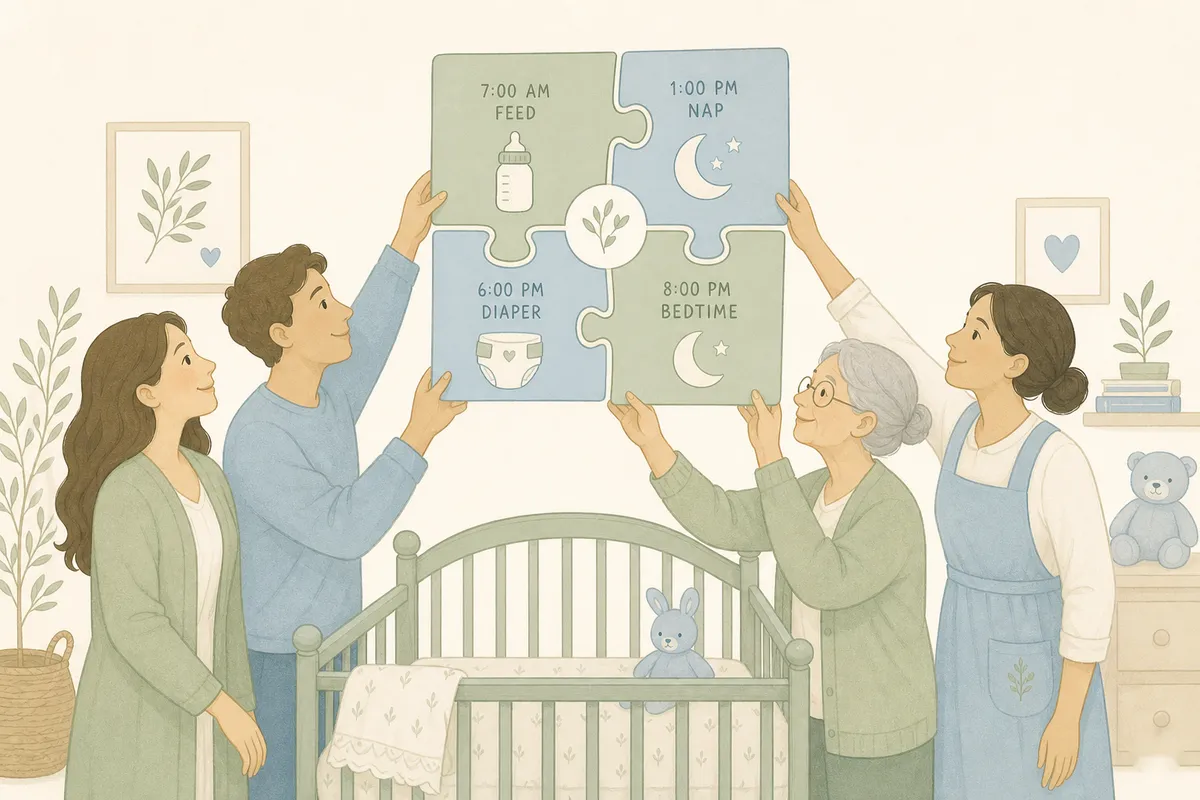
The Wednesday-afternoon grandparent is the gentlest case. Without the log, the afternoon starts with a debrief she half-remembers and ends with a call to ask how the day went. With viewer access, she opens the log before she arrives, sees the nap was short, and plans a quiet afternoon. The how-is-she call disappears, and what replaces it is better: she already knows, so she calls about something else, or just sends the porridge photo comment everyone was waiting for.
The nanny is the sharpest case, because her shift is the job. A handover built on memory gives her the first fifteen minutes of guesswork: when did he last eat, is he due a nap, did the rash cream go on. A handover built on the log gives her the morning in one glance, and she can spend those fifteen minutes on the baby instead. And the person on duty reads the baby, not the notes: hunger shows in the hands-to-mouth and the rooting long before it becomes crying, and that early cue is the one to act on.4
One bottle-feeding detail prevents a daily scramble here: expressed milk keeps up to 8 days in the fridge and about 6 months in the freezer, so whoever holds the baby holds a full pantry, as long as everyone logs what they used.5 The log answers “is there milk?” before the question is asked, which at 7 p.m. with a hungry baby is the only version of that conversation anyone wants.
What a shared log will not fix
A shared log is a mirror, not a referee, and you deserve to hear that plainly. It shows who fed, who soothed, who got up. It does not divide the night, and it will not make an unfair split fair. The imbalance between parents has a long name and a longer history; researchers were writing about the second shift, the unpaid work that starts when the paid work ends, decades before the first baby app existed.6 An app does not settle that argument. It makes the argument visible.
Used well, that visibility helps. If one of you is logging 90% of the entries, the timeline will say so plainly, and that is a conversation to have at the kitchen table, fully awake, with coffee. Used badly, the log becomes a receipt, waved around as proof. Log for each other, not at each other. The record is there so that nobody has to ask. It was never meant to be evidence.
The other thing a log will not do is replace the person on duty’s judgment. The log says the nap was short. The parent holding the baby decides what to do about it. Both matter, in that order.
Set it up tonight
The whole setup fits inside one evening:
- Add your baby’s name and birthday to create the profile.
- Invite your partner by email, and anyone else who cares for the baby: grandparents, the nanny, whoever holds the baby holds the log.
- Log the next feed. From that entry on, the day is shared.
The trial is 14 days, free, no credit card. One household plan covers everyone you invite, at 6 euros a month or 60 a year. Start it tonight, and the 11:47 text tomorrow reads differently: not did she eat, but did you see what she did.
Questions couples actually ask
Does my partner need to install an app? No. Storklet runs in the browser on any phone, so there is nothing to download or update. If they want an icon on the home screen, they can add the page to it in two taps, and it behaves like an app from there.
Can the nanny or grandparent see everything? Only what you choose. Permissions are per person: logging, viewing, health records, growth records. A nanny can log feeds and naps without seeing medical notes; a grandparent can follow along without being able to change a thing. You can adjust or revoke access at any time.
My mum is not technical. Is this realistic for her? Viewer access asks nothing of her but opening a link. There is no account setup to manage, no feed to configure, no buttons she has to press. If she can read a text message, she can read the day’s timeline.
Does it work without signal? Yes. Entries made offline save on the phone and sync when the connection returns, so a signal-free park or a long flight is covered. The record does not care where the logging happened.
What does it cost? One household plan, 6 euros a month or 60 a year, covering every caregiver you invite. The 14-day trial is free and needs no credit card, so you can test the two-phone life before paying anything.
Can our pediatrician see the records? Yes, if you invite them. Read-only access to growth charts, vaccines, and health notes, which turns the next appointment from memory-recall into a shared look at the actual record.
Sources and Further Reading
We base our explainers on high-quality academic research and public health standards.
- The survey is the Pew Research Center’s 2015 look at how working parents share the load. In households where both parents work full time, about two-thirds of parents said the mother does more of managing the children’s schedules and activities, and the parents disagreed about how equal the split was: fathers were considerably more likely to call it even. Everyone thinks they do their share. The log, unlike memory, keeps score without taking sides. Pew Research Center: Raising Kids and Running a Household↩
- The feeding frequency comes from the CDC: newborns breastfeed about 8 to 12 times in 24 hours in the early weeks. Add naps, diapers, drops, and tummy time, and a single day of a newborn’s life is twenty-something loggable events. Nobody’s head is a filing cabinet, least of all at 3 a.m. CDC: How Much and How Often to Breastfeed↩
- Richter and colleagues followed more than four thousand German parents for years after the birth of a child. In the first three months, mothers’ sleep dropped by about 62 minutes a night and fathers’ by about 13. Six years later, neither had fully recovered. The child learns to sleep through the night long before the parents recover from it. Sleep (2019): Long-term effects of pregnancy and childbirth on sleep satisfaction and duration↩
- The early hunger cues: hands to the mouth, head turning, lip smacking. Crying is the late sign, the alarm that fires after the early ones were missed. Whoever is holding the baby, the sequence is the same, which is one reason handovers work: cues transfer even when context does not. CDC: Signs Your Child Is Hungry or Full↩
- The NHS storage rules: expressed breast milk keeps up to 8 days in the fridge, 6 months in the freezer, and should be used within an hour once the baby has started the bottle. Never reheated in a microwave. Write the date on the bottle. Future you, half-asleep, says thanks. NHS: Expressing and storing breast milk↩
- Arlie Hochschild coined “the second shift” in 1989 for the unpaid work that starts when the paid work ends. The phrase stuck because everyone recognized the kitchen it described. Four decades of research later, the shift is shorter but still not evenly shared, and no app changes that. What an app can do is put the split on the table where both of you can see it. Penguin: The Second Shift↩
Read Next
Newborn Feeding Schedule by Age: Full First Year
There is no single newborn feeding schedule. There are two rulebooks, one for breastfed babies and one for formula-fed babies, and a shape the first year follows. Here it is, with the numbers and the why.
Vaccine Schedule at 2 Months: What to Expect
The 2-month visit is the biggest vaccine day of the first year. Here's what's due, what happens in the room, what's normal afterward, and when to call.